
I may receive commissions from purchases made through links in this article at no additional cost to you. Read full disclosure.
Less famous but more tasty than its cousin stinging nettle, Canadian wood nettle is an edible wild plant worth getting to know. Grab your foraging gloves and a big bag, and get ready to harvest some delicious nutritious wild greens.
WHAT IS CANADIAN WOOD NETTLE AND IS WOOD NETTLE EDIBLE?
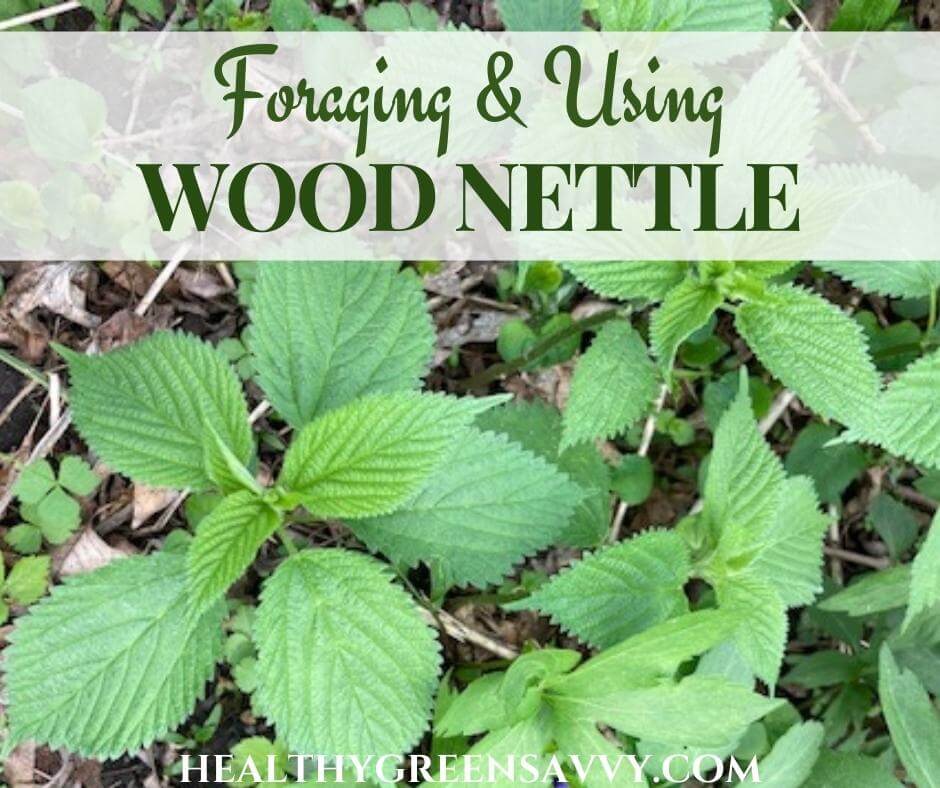
Canadian wood nettle (Laportea canadensis) is in the same family as better-known stinging nettle (Urtica dioica), a much-loved wild plant appreciated by foragers and herbalists alike. Appearing just a little after stinging nettles, you will often find wood nettles growing right next to them.
Wood nettles are native to North America, while stinging nettles are native to Europe. They’re used in similar ways, though most people who have sampled both strongly prefer Canadian wood nettle.
Both stinging nettle and Canadian wood nettle are not only edible, they’re delicious! More on how to use them below.
CANADIAN WOOD NETTLES VS. STINGING NETTLES
Stinging nettles are better known because of their long history as a medicinal and culinary plant in Europe, where they’re native. Wood nettles share most of stinging nettles’ properties and are used by North American foragers and herbalists in much the same way.
Importantly for those of us dealing with seasonal allergies, most find tea made from wood nettles more palatable than strongly-flavored stinging nettle leaf tea.
When I learned that my husband might enjoy wood nettles more in tea than the stinging nettle infusion he’d choked down each spring, I gathered up a ton of them, dried them on the herb drier, and bagged them up for the following spring. He’s finishing his last bit of Canadian wood nettle tea as the spring pollen multiplies, and I’m gathering more to use fresh till the worst of the season is over for him.
Here are other natural remedies for seasonal allergies if you need them.
For cooking, wood nettles’ flavor is considered less mineral-y and more floral, but both are well loved for using as a cooking green or making into a springtime soup.
In The Forager’s Harvest, Samuel Thayer proclaims wood nettle “the superior vegetable by a wide margin.”
Young plants’ stingers are less pronounced than those of stinging nettles, but older plants have larger stingers that can hurt more. Best to bring some gardening gloves and protect yourself!
CANADIAN WOOD NETTLE BENEFITS
Though there’s little in most herbalism books about Canadian wood nettle, the American herbalists I’ve spoken to use it the same way they use stinging nettle, and often prefer our native nettle because many people find its flavor more palatable.
In addition to their use with seasonal allergies, nettles are considered a tonic and diuretic and are sometimes used for pain relief. Ethnobotanist James Duke also recommends them for bronchitis and asthma.
Native Americans have used Canadian wood nettles as a diuretic, for urinary problems, and to address fever.
CANADIAN WOOD NETTLE IDENTIFICATION

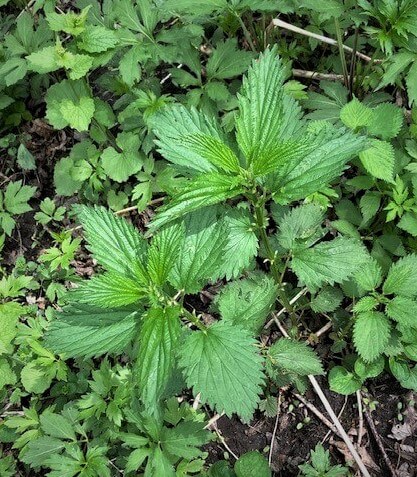
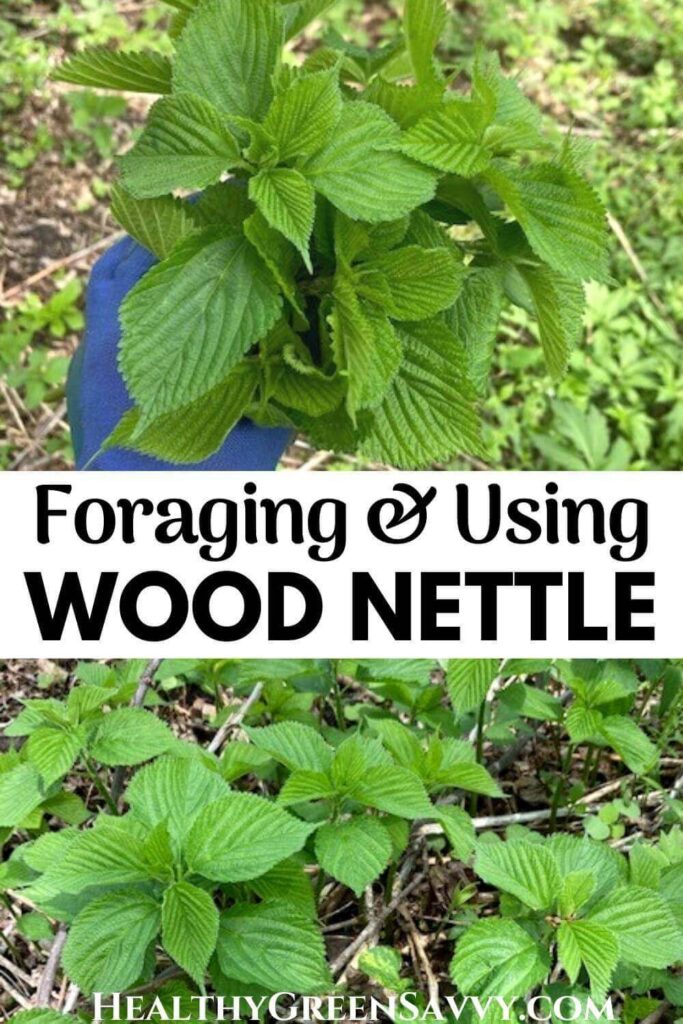
Leaves: Unlike the thin leaves of stinging nettle, wood nettle’s leaves are oval with pointed tips. Growing up to 7 inches long on petioles that can reach several inches in length, leaves are toothed and covered with fine hairs.
Growth habit: Laportea canadensis can grow up to 5 feet tall, though those growing in shady conditions tend to be considerably smaller. You’ll often find large stands of them growing together.
Flowers: Flowers are greenish, growing in small clusters lower on the plant and in a large flat panicle at the top.
Habitat: Moist areas, especially low-lying forest floors and alongside streams and creeks.
Range: Found in much of eastern North America, from Nova Scotia south to Florida and west to North Dakota.
CANADIAN WOOD NETTLE LOOK ALIKES
Individual leaves may resemble white snakeroot, a poisonous plant worth learning to identify. White snakeroot has small hairs that don’t sting, and darker green leaves arranged in an opposite rather than alternating pattern. The flowers are very different if you happen to be collecting during the flowering period. This helpful video goes over the differences.
Close relatives slender nettle (Urtica gracilis) and dwarf nettle (Urtica urens) are also edible. Dwarf nettle is known for its especially potent stingers, so take care harvesting.
Small spike false nettle (Boehmeria cylindrica) could be considered a wood nettle look alike. It’s another member of the nettle family, but lacks the sting of its relatives. It has similar oval leaves, but they’re arranged in an opposite rather than alternate pattern along the stem. Clearweed (Pilea pumila) is another. It has shiny leaves that together with its lack of stingers will help distinguish it from Canadian wood nettles.
Some sources say both these plants are edible, while others say it isn’t. If you find a trustworthy source saying one or the other, please leave a comment!
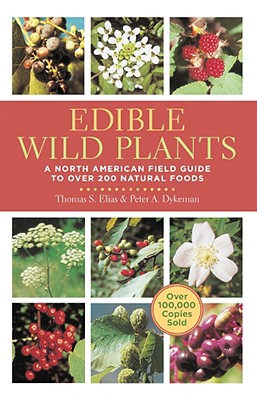
–> ALWAYS consult a good foraging guide to make certain you’re correctly identifying the plants you’re after. Check out some top recommendations for the best foraging books to keep handy for your next foraging adventure.

Interested in learning more about foraging? Consider taking a foraging class in your community, or find one online. The Herbal Academy’s online foraging course teaches plant identification, ethical wildcrafting practices, and much more.

PARTS USED
Stems, especially when younger, can be boiled or steamed and served like asparagus. Very tasty!
Leaves can be used as a cooking green or used to make a nutritious green tea throughout the growing season.
Samuel Thayer reports that in the fall, the seeds can be collected and used like flax in hot cereal or baked goods. It sounds a bit labor-intensive, so I haven’t tried it. If you do, leave a comment and let us know what you think!
HARVESTING TIPS
Like stinging nettles, Canadian wood nettles sting as you pick them, more as plants get older. Bring gloves and scissors for harvesting.
Cut plants a few inches above the ground and collect them in a paper bag or basket. It’s quick work to gather a lot. On a recent foraging expedition to a nearby stream, I filled a shopping bag with in a matter of minutes.
When you get home, submerge them in water to remove dirt and bugs, then dry in a salad spinner. They should keep in the refrigerator for a week or two, or plan to freeze or dry them before then.
–> If the stings bother you while harvesting, try rinsing with some cool water, or look for jewelweed and squeeze some of the juice onto the irritation.
HOW TO COOK WOOD NETTLES
To eat as a spring vegetable, lightly steam leaves and young stems. About 5 minutes will deactivate their sting. You can also boil them till tender. If you do, save the cooking water, as it’s basically nettle tea. You can drink it plain or use it as a base for soup.
You can also saute young stems and leaves in olive oil or butter.
Like stinging nettles, wood nettles make a tasty pesto. Check out this recipe from Mountain Rose Herbs.
Nettles are a natural for spring green soups or frittatas. Here’s a nettle soup recipe to try. This nettle frittata looks amazing!
Nettles would likely also work in many of these lambs quarter recipes.
PRESERVING WOOD NETTLES
In addition to cooking fresh, I highly recommend preserving some of this nutritious vegetable for later use either as a cooking green or dried tea ingredient.
Because we use all I collect for tea and our freezer is perpetually stuffed with homegrown rhubarb and summer ratatouille, drying is my preferred method for preserving the spring harvest of wood nettles. Here’s more on preserving herbs.
To freeze, blanch nettles in salted water for 30 seconds before submerging in cold water. Squeeze out excess water and freeze in an airtight bag or container.

I highly recommend a collapsible drying screen. I love that it has tons of space for laying out the many different herbs I gather each season but folds up into a small circle that I can tuck away out of season.
I’ve used it to dry huge quantities of foraged Canadian wood nettle, plantain, linden flowers, goldenrod, elderflowers, birch leaves, and so much more.
The thin leaves of Canadian wood nettle dry readily in air without a dehydrator. I love my collapsible drying rack, which lets me dry many layers of greens and herbs in a small space. Given how easy it is to gather up a huge amount, you can wind up with a nice stockpile of dried leaves with very little effort.
You can also make a long-lasting tincture with wood nettle using these instructions for making stinging nettle tincture.
WOOD NETTLE TEA RECIPE
To make wood nettle tea, take about 2 cups loosely packed fresh leaves (or 1/4 cup dried leaves) and cover with 4 cups freshly boiled filtered water.
Allow to steep for at least 10 minutes and up to several hours. Strain and enjoy.
Tea made from fresh leaves will have a brighter, grassier flavor than that made from dry.
Have you tried Canadian wood nettle? What do you like to do with them?
If you love foraging nutritious wild plants in your area, be sure to check out some of these other options:
- Foraging Juneberries
- Foraged Mulberry Leaf Tea
- Foraging and Using Wild Spinach (Lambsquarters)
- Foraged Ginkgo Biloba Tea
- Identifying & Using Goldenrod
- How to Make Pine Needle Tea
- 25 Edible Wild Greens
Pin to save this info on Canadian wood nettle for later!
Susannah is a health and environmental writer focusing on gardening, foraging, medicinal plants, and sustainability. Her work has appeared in Mother Earth Living, Ensia, Northern Gardener, Sierra, and on numerous websites. Her first book, Everything Elderberry, released in September 2020 and was a #1 new release in holistic medicine, naturopathy, herb gardening, and other categories. Find out more and grab your copy here.

 Hi, I'm Susannah, a garden geek, energy nerd, and fan of healthy food and natural remedies. Need some simple, practical solutions for living healthier and greener? You've come to the right place! More about me and my green projects
Leave a Reply