
I may receive commissions from purchases made through links in this article at no additional cost to you. Read full disclosure.
Though many people don’t know the difference between ragweed and goldenrod, they’re not difficult to tell apart. Here’s what to know about identifying goldenrod vs ragweed.
When you see yellow flowers in early fall do you blame your allergies on ragweed? While you’re probably right it’s the ragweed making you sneeze, if the plant you’re blaming has golden flowers, it’s not the one causing your problems.
GOLDENROD VS RAGWEED, OFTEN-CONFUSED PLANTS
Both in the aster family along with calendula, dandelions, sunflowers, buzz buttons, chamomile, and many more, ragweed and goldenrod have similar bloom times and tend to grow in the same places. Probably because goldenrod’s showy yellow flowers are so visible compared to inconspicuous ragweed, people assumed it was all those beautiful blooms that were causing their seasonal allergies during ragweed season.
It’s too bad, because goldenrod is actually a really helpful plant for alleviating (not causing) seasonal allergies!
Both grow in much of North and South America, and Australia, as well as parts of Europe, Asia, and Africa.
Goldenrod is the common name given to members of the Solidago genus. There are more than 100 Solidago species growing worldwide. Solidago canadensis is the species you’re most likely to find growing in North America.
The name Solidago means ‘to make whole’ or ‘heal’ in Latin because it was considered useful for treating wounds. Goldenrod has many additional medicinal uses, including as an antimicrobial, astringent, lymphatic, and anti-inflammatory. It’s also a source of antioxidants.
Ragweed belongs to the Ambrosia genus and is considered invasive in North America. It, too, has a long history of medicinal use. This monograph goes over many of ragweed’s herbal applications in detail. Ragweed is also one of many edible weeds for the forager to explore, though perhaps not for those with ragweed pollen allergies. More on ragweed as an edible wild plant here and here.
DIFFERENCES BETWEEN GOLDENROD VS RAGWEED
One key difference between goldenrod and ragweed to know is that ragweed causes allergies and goldenrod doesn’t. A single ragweed plant can produce a million tiny grains of pollen per day, which is easily carried by the wind, making it responsible for elevated pollen counts in later summer and early fall. Ragweed pollen allergies are one of the most common allergies in North America.
Goldenrod’s heavier pollen requires insects for pollination, and you will see goldenrod plumes simply crawling with busy bugs while flowers are blooming.
As for correctly identifying goldenrod vs ragweed, two features will help you easily learn the difference between these often-confused plants.
To tell the difference between ragweed and goldenrod, compare their flowers and leaves. The photos and descriptions below should help.
Goldenrod vs ragweed flowers

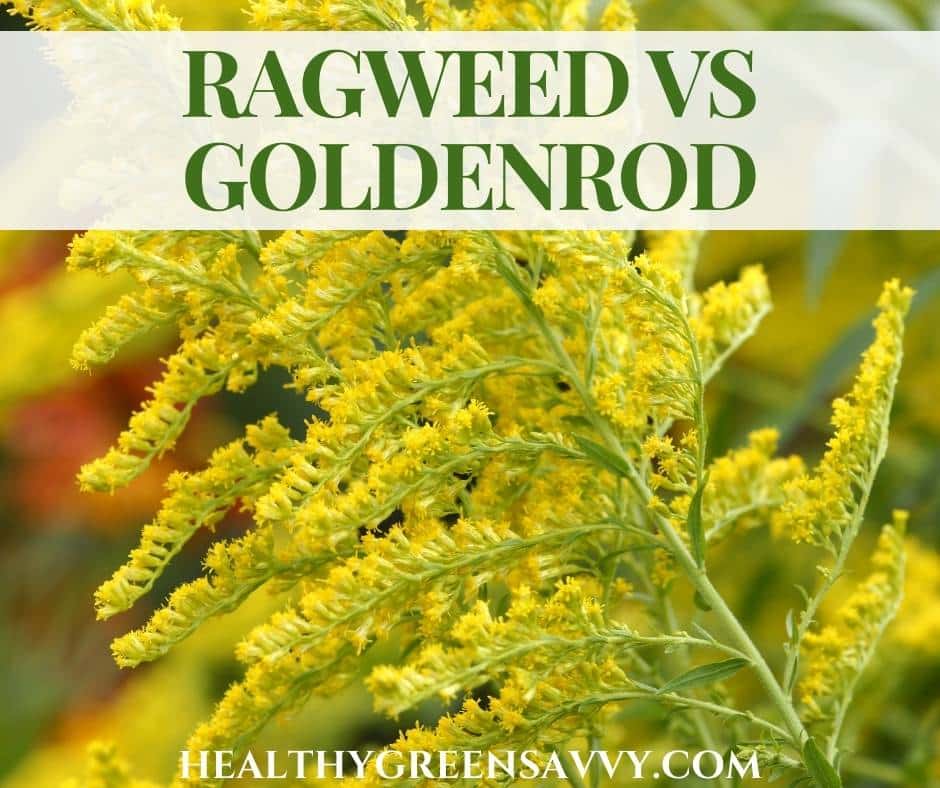
The easiest way to identify goldenrod vs ragweed: Goldenrod has plumes of showy yellow flowers (like those above) while ragweed’s green flowers (below) can be quite hard to see.
If you’re seeing bright yellow flowers, you’ve got goldenrod, not ragweed.
Goldenrod’s inflorescences spread into flat branching clusters at the top of the plant. The individual flowers are small, about 1/8 of an inch across, each with 8 to 15 petals.
Ragweed produces flower spikes 1 to 4 inches long. Ragweed’s small, petal-less flowers start green and become yellowish green.
Goldenrod vs ragweed leaves
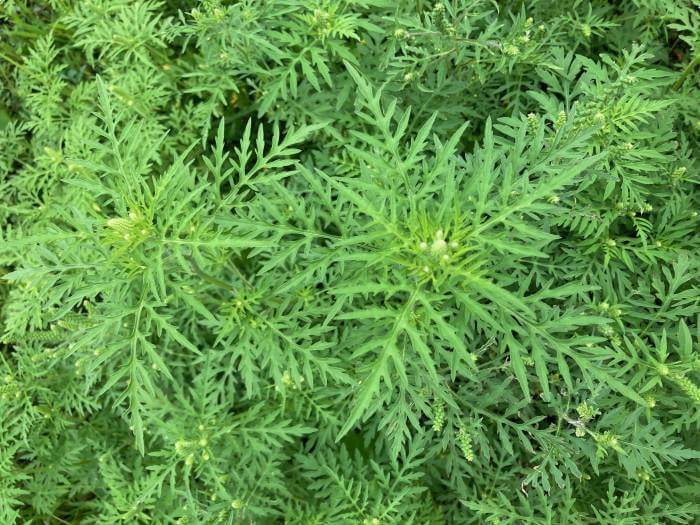
The leaf shapes of goldenrod vs ragweed are also very different: Goldenrod has lance-shaped leaves with pointed tips that attach individually to the stem. Ragweed, on the other hand, has deeply-lobed leaves that almost look like compound leaflets attaching together on a single stem.
Compare the leaves of ragweed above to those of goldenrod below and you’ll see how easy is it to tell the difference between ragweed and goldenrod.
Goldenrod leaves are 1 to 4 inches long. They radiate out from the central stems in an alternate pattern.

Here’s more on goldenrod identification as well as the many goldenrod benefits and uses to explore now that you’re no longer blaming goldenrod for your allergies!
-> Remember, always consult a good field guide to ensure sure you’ve correctly identified the plants you’re foraging.
Here are the best foraging books I’ve found, and these are the best herbalism books I’ve read if you’d like to have some helpful references as you dig deeper into the world of plant medicine.
Check out the Herbal Academy’s online foraging course, which can help you gain skills and feel more confident when you forage.

DOES GOLDENROD CAUSE ALLERGIES?
Goldenrod’s heavy pollen isn’t carried by the wind like ragweed’s, so it’s generally not considered a culprit in the case of seasonal allergies. However, like ragweed, it is a member of the aster family, so people with known ragweed allergies may want to be cautious about consuming it.
While I haven’t found sources suggesting that people sensitive to ragweed may have issues with goldenrod, cautions about other members of the aster family, such as chamomile, daisy, and dandelion are common, so I would think if you suffer from ragweed allergies, you might want to make sure that goldenrod doesn’t aggravate it as well.
If other plants cause your allergies, goldenrod is considered among many plants considered helpful natural remedy for seasonal allergies. Goldenrod can be taken as a tea or a tincture. Here’s an easy goldenrod tea recipe to try.
Now that you can confidently tell the difference between goldenrod and ragweed, go enjoy the show goldenrod puts on at the end of the season. And if the ragweed pollen bothers you, you could see if goldenrod helps alleviate them.
Want to know how to correctly identify other commonly confused plants? Check out these posts:
Find lots more on plant identification in our foraging archives.
Pin to save this info on goldenrod vs ragweed for later!

Additional goldenrod vs ragweed photo credits: schnuddel, chrispy_muc, AdventurePicture
Susannah is a health and environmental writer focusing on gardening, foraging, medicinal plants, and sustainability. Her work has appeared in Mother Earth Living, Ensia, Northern Gardener, Sierra, and on numerous websites. Her first book, Everything Elderberry, released in September 2020 and was a #1 new release in holistic medicine, naturopathy, herb gardening, and other categories. Find out more and grab your copy here.

 Hi, I'm Susannah, a garden geek, energy nerd, and fan of healthy food and natural remedies. Need some simple, practical solutions for living healthier and greener? You've come to the right place! More about me and my green projects
Carol L says
Nice post. I was REALLY hoping to find a comparative photo (close up) of both plants in full bloom! That would have been a great addition for all to compare. You have one photo of blooming ‘something’ but no note to WHICH plant it is. Confusing!
You have the leaves in closeup with notes, but only one of the flowers, and the flowers are what is going to draw us to the plant to figure out which it is.
Susannah says
Hi Carol,
Thanks for noticing that the caption to the goldenrod photo somehow got deleted. It’s back now. I’ve been waiting for the flowers to bloom so I can get a photo of the two plants side by side. I’ll add that as soon as they’re ready. Thanks!
susan brooks says
I am interested in ransplanting some goldenrod to my garden.
When is the best time to do this in zone 7?
Thanks for all the very valuable and useful information you share.
Sue Brooks
Susannah says
In general, transplanting in fall after a plant has finished flowering is recommended, and this should work well for goldenrod as well. Hope they thrive for you!
Sharon Knox says
Hello there,
I really enjoyed your article, and can appreciate the amount of time that went into it. I myself know the difference between theses two plants, but wanted to show somebody the information so they might stop blaming goldenrod for their allergies. However, we live in Wisconsin and have a different variety of ragweed, which leaves look similar to a large goose foot. Making mention of the different variety of leaf identification might be helpful to some.
Thank you,
Sharon
Susannah says
Thanks for your suggestion, Sharon! Do you know the name of the type you have or could you send a photo? If I had an image to include I could add it. Thanks!
Anna says
It says that those with ragweed allergies should be cautious about consuming goldenrod, but then suggests a goldenrod tea to alleviate ragweed symptoms? I don’t understand. Currently suffering from all the ragweed in western NY.
Susannah says
Hi Anna,
As mentioned in the article, you’ll often see warnings that people with ragweed allergies avoid consuming plants in the aster family, like chamomile. I’ve seen lots of herbalists suggesting goldenrod for seasonal allergies because of its value as a respiratory herb, however. I just raised the usual aster caution as something to be aware of. You might want to explore these other natural remedies for allergies if you decide goldenrod isn’t for you.