


I may receive commissions from purchases made through links in this article at no additional cost to you. Read full disclosure.
Looking for birch trees to make some delicious birch tea? Here’s what to know about identifying birch trees and how to tell them from aspen trees, which people often mistake for birch. Read on to learn about distinguishing birch vs aspen trees.

While many plants are a snap to identify, some require us to pay more careful attention, like distinguishing spruce vs fir vs pine, catnip vs catmint or spurge vs purslane.
Birch and aspen trees are often confused because they have similar growth habits and both can have white bark that stands out in the landscape.
A little closer inspection of their leaves and bark will help you easily tell a birch tree from an aspen tree.
BIRCH VS ASPEN TREES
Both birch and aspen are common trees in North America and Europe, and you’ll find them both in residential landscapes as well as in forests.
Birch is the common name for the Betula genus and includes many species of birch tree. It’s the birch commonly known as ‘paper birch’ that people are most likely to confuse with aspen trees.
Aspen, often called quaking aspen (North American Populus tremuloides or European Populus tremula) is a species in the poplar genus, as you’ll note from their botanical names.
Both birch and aspen are medicinal trees that have been traditionally used as food and medicine by numerous Native American tribes.
The Peterson Guide to Medicinal Plants and Herbs mentions that many tribes used aspen bark in tea or tincture for colds and fevers as well as externally as a poultice for wounds, rheumatism, and pleurisy. Authors Stephen Foster and James Duke report that aspen bark contains salicin, an analgesic compound with activity similar to aspirin.
Birch bark and leaves contain methyl salicylate, another aspirin-like compound, leading to its traditional use as an analgesic as well. Native Americans also used birch for gastrointestinal problems and to soothe skin conditions.
FORAGING BASICS
Whenever you forage a new plant, make sure you positively identify it using multiple features of the plant.
–> Always consult a good field guide to ensure you’ve correctly identified the plant. Here are some of the best foraging books to consider adding to your reference library.
You might also consider taking a course on foraging, either with a local expert or online. The Herbal Academy offers an online foraging course that can help you gain confidence identifying and foraging wild plants. They also have loads of great herbalism courses to check out.

IDENTIFYING BIRCH VS ASPEN TREES
Wondering if you’ve found an aspen or a birch? Here’s how to tell them apart.
The descriptions below focus on paper birch vs aspen, the two trees commonly mistaken for one another. For additional information on other birch species, read the birch identification section in the post on birch tea.
GROWTH HABIT

Aspens and birches both can grow up to about 70 feet tall, though less mature trees will obviously be shorter.
Their growth habits can be somewhat different, but that’s not the most reliable feature to use in your identification. Birch trees may grow multi-stemmed, but often they’ll grow singly as well.
The birches planted in my area tend to have a broader canopy than the aspens, but growing close to one another in a forest, you may well find both with far narrower growth habits. Some cultivars used in residential plantings also have a more compact growth habit.
However, aspens have an unusual characteristic that may not be apparent to the eye but is fascinating nonetheless. Aspen trees grow in huge colonies connected underground. Rather than reproducing by seed, aspen trees grow as clones from the large connected underground organism. These colonies can reportedly live thousands of years.
BIRCH VS ASPEN BARK
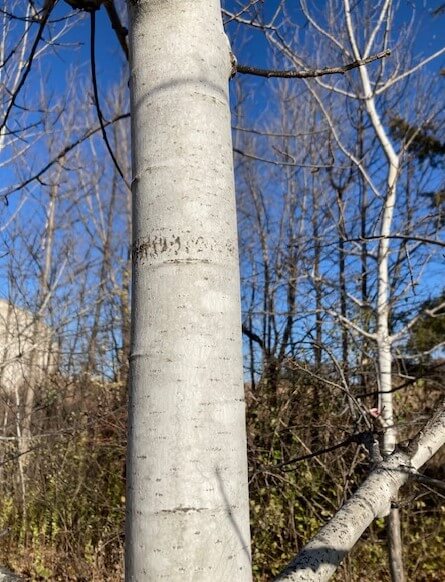
The easiest way to identify birch vs aspen at any time of year is the bark.
While birch and aspen trees both can have white bark with black ‘scars’, birch bark will look like it’s peeling off the tree, while aspen bark does not, as you can see in the photos below.

BIRCH VS ASPEN LEAVES
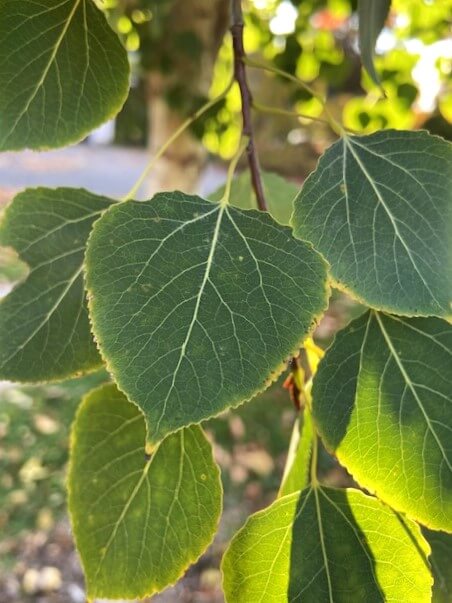
An additional way to distinguish birch vs aspen trees is to look at the leaves during the growing season. Birch tree leaves are elongated ovals with pointy tips and serrated edges. They emerge from the branch in an alternating pattern and are typically 2 to 3 inches long.
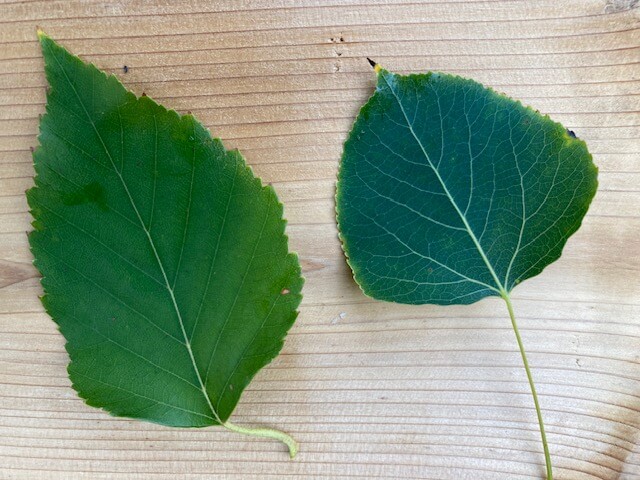
Birch leaves have a raised midrib, while aspen leaves are very flat. Aspen leaves have more of a heart shape and tend to be smaller.
FLOWERS
In the spring, birch trees grow long clusters of flowers called catkins, which stay on through the season.

Aspen, on the other hand, rarely flower and do not produce catkins.

HOW TO USE BIRCH AND ASPEN
Foragers generally use birch leaves, bark, or twigs to make a pleasant-tasting tea that has a number of medicinal uses. Read more about making birch tea if you’re curious.
Birch sap may also be tapped for syrup, and the inner bark can be used to make flour. Note that you shouldn’t harvest bark from a living tree. Look for fallen branches, or harvest from a tree that’s being felled.
And of course, there’s birch beer, which can made as a kind of soda or an alcoholic beverage. This post from The Crunchy Urbanite explains how to make the soda version from syrup derived from collected twigs, while this one from Wilderness College uses birch sap and ferments for a few weeks.
Birch bark and leaves can also be infused in oil to make a pain-relief salve.
As mentioned above, the aspen was used medicinally by several Native American tribes. Samuel Thayer (author of the BEST EVER foraging guide) notes that if an aspen is being felled, the inner cambium may be harvested as a “slushy treat.”
Now that you know how to tell birch vs aspen, check out some of our other foraging guides and add to your plant knowledge:
Save this info on identifying birch vs aspen for later!
Disclaimers: Though HealthyGreenSavvy and EcoSavvy Writing LLC always aim to provide thorough and accurate information, we assume no liability or responsibility for any consequences, health issues, or symptoms that arise from ingesting or touching any plant described on this website. It is always the reader’s responsibility to ensure accurate plant identification and use multiple reputable sources to confirm. If you have any doubts about the identification of any plant, do not eat it.
Additional photo credits: cover photo by 153photostudio; pin photos by Elena Shutova and arinahabich
Susannah is a health and environmental writer focusing on gardening, foraging, medicinal plants, and sustainability. Her work has appeared in Mother Earth Living, Ensia, Northern Gardener, Sierra, and on numerous websites. Her first book, Everything Elderberry, released in September 2020 and was a #1 new release in holistic medicine, naturopathy, herb gardening, and other categories. Find out more and grab your copy here.

 Hi, I'm Susannah, a garden geek, energy nerd, and fan of healthy food and natural remedies. Need some simple, practical solutions for living healthier and greener? You've come to the right place! More about me and my green projects
Leave a Reply