

Wondering if that plant in your garden is yummy purslane or toxic spurge? Here’s a detailed description to help you correctly identify spurge vs purslane.
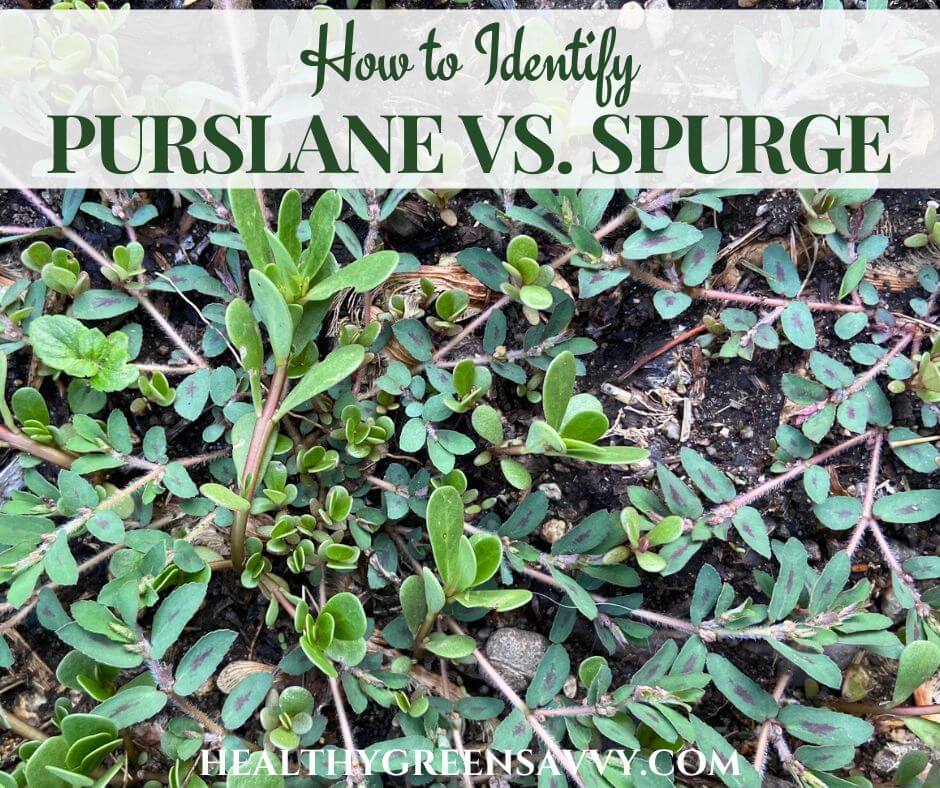
Many people think purslane is a weed and don’t realize they’re yanking up a bonus delicious vegetable from their garden beds. Once you get to know this cool plant, you’ll be seeking it out, but be sure you know how to tell the difference between edible purslane and spurge, a poisonous plant. Read on to learn how to tell them apart.
WHY DO YOU NEED TO KNOW THE DIFFERENCE BETWEEN SPURGE VS PURSLANE?
The first rule of foraging is to make ABSOLUTELY certain you’ve got the right plant for consuming it. Since you probably landed here after doing an online search for how to tell spurge from purslane, you likely already know that many very tasty plants (like purslane) have toxic look alikes you need to be aware of when you forage.
That’s why you should always consult a good field guide or go with an experienced forager to make sure you correctly identify the plant you’re foraging.
Foraging expert Samuel Thayer has released a fantastic new guide, the most comprehensive I’ve ever had the pleasure of thumbing through. I’ve consulted his three previous books many, many times in my years of foraging, so I was thrilled that he’d written a guide compiling his extensive plant knowledge in one incredible book. Covering 679 species (nearly twice that in the Peterson Guide), this is a must-have for the forager’s bookshelf. You can order it at Bookshop.org or Amazon, or get one direct from the author’s website.
If you’re looking for others, read more about the best foraging books available.
You might also consider taking a class. The Herbal Academy offers an online foraging course to help you master plant identification and gain confidence foraging edible wild plants. They also have numerous herbalism courses worth checking out. Tap the banner below to check out their course offerings.

UNDERSTANDING DIFFERENCES AND SIMILARITIES OF SPURGE VS PURSLANE
When you first get into foraging, there are some important things to get clear on right away, foremost among them how to correctly identify common poisonous plants. Spurge is one of those plants you should learn to spot, and since it’s often confused with one of the best plants to forage, purslane, best to be very sure about how to tell spurge vs purslane.
We aim to clear up confusion as much as possible here at HealthyGreenSavvy, so today’s project is clarifying how to tell poisonous spurge vs purslane. The first is a common toxic weed and the second is a nutritious edible wild plant. Every forager should learn to recognize both.
Some other commonly confused plants we’ve covered include goldenrod vs ragweed, catnip vs catmint and spruce vs fir vs pine. You can find more on identifying plants to consider foraging in our foraging archives.
Why might someone mistake spurge for purslane? Purslane and spurge share some basic characteristics:
- They’re both creeping annual weeds
- They both have red stems
- They both have oval leaves
- They favor the same growing conditions and are often found right next to each other

Once you’ve learned how to identify purslane correctly, here’s a collection of purslane recipes to try out! I’m especially fond of this anti-inflammatory smoothie made with purslane.
SPURGE VS PURSLANE: IDENTIFYING FEATURES
Two common spurges resemble purslane. Prostrate spurge (Euphorbia prostrata) and spotted spurge (Euphorbia maculata) are very similar to one another. Like purslane, they’re creeping plants with reddish stems that often grow near or even intertwined with purslane. Learn the key differences between purslane and spurge outlined below and be sure to avoid inadvertently picking some spurge when you’re harvesting purslane.
I mainly found spotted spurge growing near me, so that’s what appears in most of the photos. You may find spurges growing that don’t have the purple spot shown here, so don’t use that feature as a primary means of telling the difference between purslane and spurge, though if you do see the spots that makes it even easier to distinguish them.
SPURGE VS PURSLANE: LOOK FOR DIFFERENCES IN LEAVES
Though the leaves of both plants are oval in shape, purslane has smooth, fleshy leaves, while spurge’s are flatter and not succulent. Purslane’s leaves have smooth edges, while spurge’s are serrated.
Spotted spurge has — you guessed it — spots on the leaves, as you can see in the photo below.
Spurge leaves grow in opposite pairs, while purslane’s leaves appear in whorl-shaped clusters growing at the end of the stems, as seen in the photos below.


In short:
Purslane: Leaves are fleshy with smooth edges, growing in groupings (usually of 4 leaves)
Spurge: Leaves are not fleshy, have serrated edges, and grow in opposite pairs
SPURGE VS PURSLANE: LOOK FOR DIFFERENCES IN STEMS
Spurge stems are thinner and aren’t succulent like purslane’s. Sometimes they will be hairy, as in the photos of the spotted spurge growing above and below. They will usually — though not always — contain a white sap that oozes out when the stem is broken. Purslane stems will not have sap.

Spurge sap can irritate your skin, so after you’ve broken the stem to identify the plant as spurge, try to avoid getting the sap on you.
Though the sap is a helpful means of identifying spurge, smaller spurge plants may not have visible latex, so it’s important to use all the features of the plant and not just the absence of milky sap to make a positive identification.
If you do accidentally consume spurge or get sap on your skin, here’s what Poison Control recommends.
In short:
Purslane: Stems are fleshy and don’t exude sap when broken.
Spurge: Stems are not fleshy and usually contain white sap that’s visible when you break the stem.

To recap, to differentiate between spurge vs purslane:
Purslane: Leaves are fleshy with smooth edges, growing in groupings at the end of stems; stems are fleshy and don’t ooze sap
Spurge: Leaves are not fleshy, have serrated edges, and grow in opposite pairs, thin stems usually exude white sap when broken
Now that you know the difference between poisonous spurge and purslane, go out and forage some of those nutritious wild plants!
Other wild plants to seek out this season:
- Wild Spinach
- Serviceberries (aka Juneberries or Saskatoons; try ’em in these delicious serviceberry recipes!)
- Edible Mulberries
- Wild Black Raspberries
- Canadian Wood Nettle
- Wild Herbs
Pin to save this info on spurge vs purslane for later!

Disclaimers: Though HealthyGreenSavvy and EcoSavvy Writing LLC always aim to provide thorough and accurate information, we assume no liability or responsibility for any consequences, health issues, or symptoms that arise from ingesting or touching any plant described on this website. It is always the reader’s responsibility to ensure accurate plant identification and use multiple reputable sources to confirm. If you have any doubts about the identification of any plant, do not eat it.
Anyone touching or consuming wild plants does so at their own risk.
Susannah is a health and environmental writer focusing on gardening, foraging, medicinal plants, and sustainability. Her work has appeared in Mother Earth Living, Ensia, Northern Gardener, Sierra, and on numerous websites. Her first book, Everything Elderberry, released in September 2020 and was a #1 new release in holistic medicine, naturopathy, herb gardening, and other categories. Find out more and grab your copy here.
 Hi, I'm Susannah, a garden geek, energy nerd, and fan of healthy food and natural remedies. Need some simple, practical solutions for living healthier and greener? You've come to the right place! More about me and my green projects
Leave a Reply