

I may receive commissions from purchases made through links in this article at no additional cost to you. Read full disclosure.
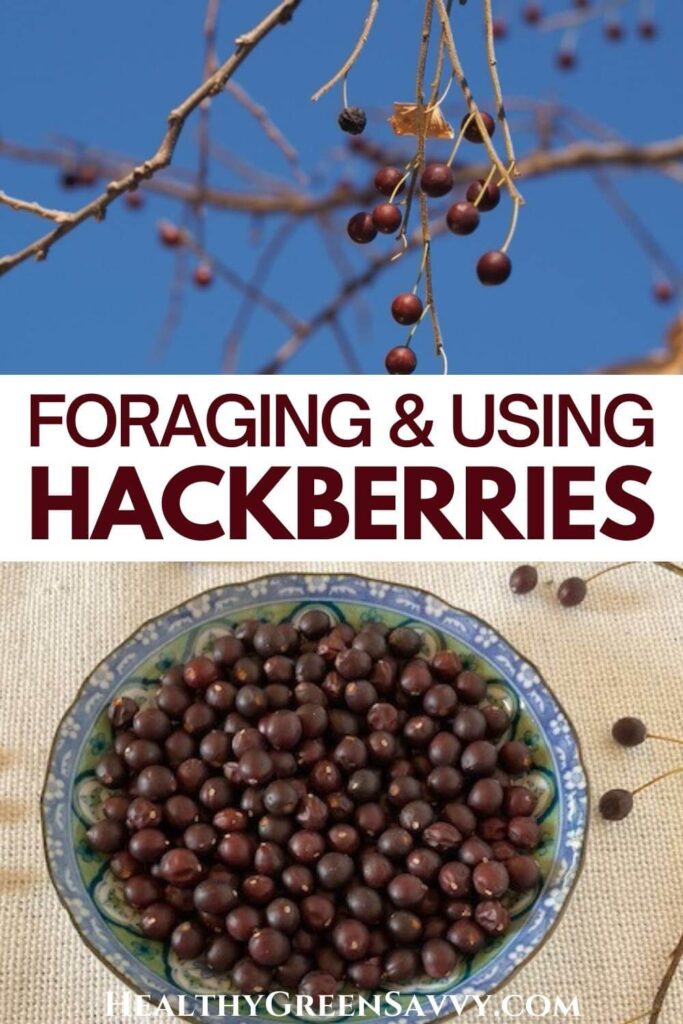
Wondering what’s still worth foraging in the cooler months? Look no further than the common hackberry tree, which produces tasty and nutritious edible fruit that hangs on all winter. Didn’t know that hackberries are edible or never even heard of them? Here’s what to know about foraging hackberry fruit, aka hackberries, sugarberries, or snackberries!
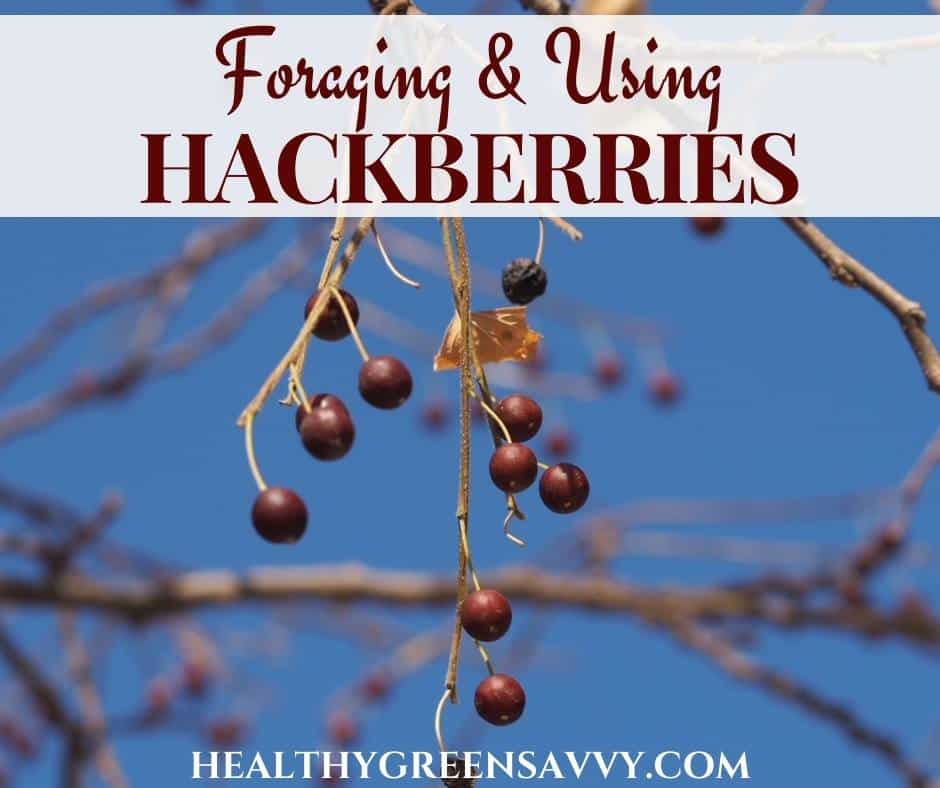
MEET THE EDIBLE HACKBERRY FRUIT
More people discover every day that it’s surprisingly easy to find nutritious food growing wild all around us. It often grows in plain sight, with none but the birds and the squirrels savvy enough to notice.
You’ve probably walked by hackberry trees dozens, if not hundreds of times, and not realized there was yummy wild food there for the taking. I just introduced a friend to the hackberry tree that’s been growing 20 feet from her door for the last 15 years, and she’d never heard of it before, nevermind tasting its sweet little fruits. She was delighted!
Hackberry’s not terribly appealing name is believed to come from early colonists, who thought it resembled a wild cherry tree common in Scotland often referred to as ‘hagberry.’ Like the unfortunately-named black chokeberry (now rebranded as ‘aronia’), the hackberry’s image is overdue for an overhaul.
In addition to all the delicious wild fruits (juneberries, mulberries, and wild black raspberries, for example) that make foraging a delight in summertime, there are some notable wild foods to be found in fall and winter that every forager should get to know. Hackberry fruit might be at the top of the list.
One of the few wild foods that contain fats, protein, and carbohydrates, hackberries are an excellent survival food to know about.
Though high season for foraging starts in spring and winds up in fall, some surprisingly tasty edible wild foods hang on through even the coldest winter. If you’ve been looking for something to forage during the frozen months, get to know hackberry fruit, the edible berry produced by the common hackberry tree (Celtis occidentalis).
If you live in the southern United States, you might also find the southern hackberry (Celtis laevigata), sometimes called sugarberry.
ARE HACKBERRIES EDIBLE? (FORAGING HACKBERRY FRUIT)
Whether you think hackberry is edible or not partly depends on how you’ve tried to consume it — and how strong your teeth are. While hackberries are edible (and actually quite enjoyable to eat), for most people they require some preparation to fully enjoy.
Long recognized as an excellent source of hard-to-come-by fats, protein, and carbohydrates in the leaner months, hackberry fruit was used by Native Americans for both food and medicine. Apparently hackberries were found in the tomb of Peking Man, suggesting that hackberries have been a food source for more than half a million years!
One of my favorite foraging experts, Samuel Thayer, features hackberry fruit in his first book, Nature’s Garden. Thayer has found that few people recognize this widely-grown tree, though he believes “it is truly one of the most important wildlife foods in North America.”
Hackberry trees produce bountifully, though, so foragers shouldn’t worry too much about claiming some hackberry tree fruits for themselves, especially since the vast majority grow out of reach of the average human.

Thayer notes that hackberry fruit deserves more attention in the category of survival food as it’s “the closest thing you can get to a complete meal from one plant. In sheer survival value it is unsurpassed, for it packs a remarkably high number of calories comprising all three sources: fat, carbohydrate, and protein.”
Hackberry trees can get very tall, which can pose a challenge for foragers trying to reach them. However, because hackberries are such tough trees, they’ve gained popularity in urban street plantings, so you may find a surprising number of them growing in easy reach of public sidewalks.
WHAT DO HACKBERRIES TASTE LIKE?
The outer layer of hackberries is quite thin and tastes remarkably like dates. The inner seed on its own doesn’t have much flavor.
If you’re trying to eat hackberries straight off the tree, the seed can seem like it’s going to be really hard, but in fact crunches up pretty easily, especially if you eat it together with the outer coating. Some hackberry seeds give far more easily than others, so don’t imperil your teeth if it feels too hard to you.
Some foragers find the inner seed too tough to chew with their teeth, and prefer to grind up hackberry fruits before eating.
Some people get seriously excited about the hackberry fruit. Check out this hilarious video from Black Forager.
HACKBERRY TREE IDENTIFICATION
Hackberry trees are easily found in wooded areas and in street plantings, since they’re such tough native species. Hackberry is an adaptable tree that grows in most regions of the globe and across much of North America, from Ontario to Florida and from Montana to New Mexico.
Six species of hackberry tree grow in North America, though by far the most common is Celtis occidentalis, aptly called in common parlance, common hackberry. Hackberry tree bark and fruit may have somewhat varied characteristics in different regions.
-> ALWAYS make absolutely certain you’re correctly identifying any plant you intend to forage. Be sure to consult a good foraging guide or a local foraging expert when foraging for the first time. Here are my top recommendations for the best foraging books.
You might also consider taking a class like the Herbal Academy’s online foraging course, which can help you gain confidence in plant identification and wildcrafting practices.

HACKBERRY TREE GROWTH HABIT
Mature trees grow on straight trunks and typically reach 50 to 70 feet tall, though they can grow up to 100 feet. Commonly infected with mites that cause to twigs to grow “witch’s brooms” — several twigs growing from the same point — which Thayer says “are common enough to be a good identifying feature of the leafless hackberry.”
HACKBERRY BARK
Bark is gray with very pronounced ridges that serve as one of its most characteristic features. If you look closely, you can see the ridges are made of thin layers that resemble sedimentary rock formations, leading some to refer to it as ‘Grand Canyon bark.’

HACKBERRY LEAVES
Hackberry leaves are typically 3 to 6 inches long with toothed margins everywhere but the base. They have a pointed tip and are usually asymmetrical, growing in an alternate pattern on the branch.
One of the hints you’ve got a hackberry tree is these gnarly-looking growths on the leaves. They’ve got the unappealing name hackberry nipple galls, and they’re caused by an infection of insects called Pachypsylla celtidismamma. Not all leaves will have them, but they’re so common that they’re a useful tool for positive IDs on hackberry trees.


HACKBERRY FRUIT
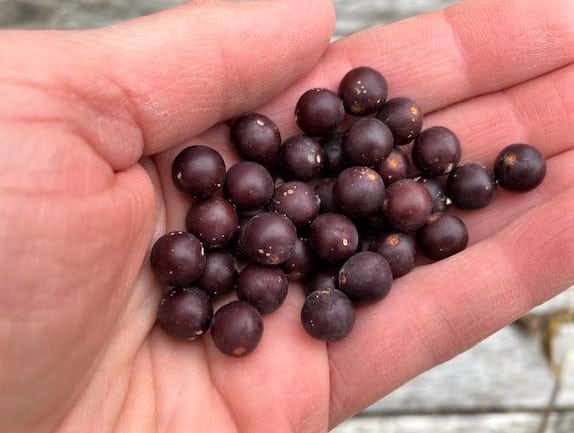
Hackberries are drupes, which means the “berry” is actually flesh surrounding a hard central seed like a cherry, plum or other “stone fruit” (elderberries are as well). But unlike cherries, whose seeds are poisonous, hackberries have seeds that are not only edible but very nutritious. Hackberries’ flesh is also far thinner than these more berry-like berries, more like a candy coating than what we think of as flesh.
Hackberries hang singly from stems and start out green early in the season. Northern hackberries take on a lovely dark purple-brown hue when ripe in late summer or fall. Some species produce hackberry fruits that are red when ripe.

About the size of green peas, hackberry fruits can be a bit labor-intensive to gather. But they can stay on through much of the winter, so when there’s nothing else to forage, they can be worth the effort. Thayer points out that measured in terms of calories, harvesting a gallon of hackberry fruit is like gathering up to 5 gallons of raspberries or blueberries, so take that into account when you decide if they’re worth your while.
Thayer notes that high winds can send hackberry fruits flying and recommends checking the ground if you’re not seeing many hackberries still on the tree.
Another little nut-like seed hangs onto abundant street trees at the same time hackberries ripen. Linden ‘nuts’ (the seeds of the common linden tree, planted everywhere it seems) are another edible tree fruit that might catch your eye as you search for hackberries among your street trees. They apparently can be ground into something that passes for chocolate, though I’ve read it’s an awful lot of work.
If you look at them up close, you’ll see how different linden seeds look.

HOW TO EAT HACKBERRY FRUIT (WHAT TO KNOW ABOUT PREPARING EDIBLE HACKBERRIES)
How to use hackberries? While tasty and an excellent survival food, hackberries aren’t terribly versatile. You have 4 main options for using them.
1. Trail Snack
While they can be nibbled straight off the tree, not everyone enjoys cracking into the hard seeds with their teeth. Some hackberry trees produce berries that are harder than others, so go ahead and try giving a whole hackberry fruit a good crunch and see if the seed gives easily. Some will, while others will feel like they might crack your tooth.
If you’ve got the latter, you might prefer to make something with your hackberries rather than eating them straight. Check out the 3 suggestions below.
But if you’ve got hackberries that break easily enough, they’re an excellent source of energy for long hikes and could really help if you ever found yourself in a survival situation.
2. Hackberry ‘Nut Milk’
The most common way people use hackberries (besides just nibbling them on hikes) is to make a nutmilk as you would other nuts, by soaking in water, blending, cooking, and straining with a nutmilk bag (like these inexpensive ones made wtih organic cotton). You’ll leave behind some of the hackberries’ nutrition this way, though.
I used a sieve rather than a bag to make a sweet liquid with some other bits left in it and mixed it with some chia seeds to make a simple chia pudding. The hackberry flavor on its own was enough to make this a pretty tasty dish, but a dash of cinnamon or nutmeg would make it even better.
But if the crunchy bits of seed aren’t something you enjoy, this naturally sweetened beverage is still a nutritious choice, retaining much of the fat and protein. You can drink it on its own, add a little cinnamon or nutmeg, or use it as a base for oatmeal, rice pudding, or baked goods.
3. Ground Hackberry ‘Candy Bar’
Modern foraging pioneer Euell Gibbons recalled using hackberries pounded together with hickory nuts as a young boy to make what he called a ‘wild candy bar.’ You can also grind up hackberry fruits on their own in a spice grinder to create little Larabar-like snacks like Black Forager does. (Seriously, check out that video. She’s so funny and enthusiastic — she’ll definitely get you fired up to go hunting for hackberries!)
Thayer reports making something similar he calls “hackberry candy” using a mortar and pestle.
4. Hackberry Hot Cereal
You can also use hackberries to make a type of porridge, like oatmeal, though having enough on hand to make more than small bowlful might mean many hours of harvesting.
To make, combine your hackberries with water and simmer on the stovetop for about 30 minutes. You might also soak them overnight before cooking to help soften them and speed the cooking process. Once cooled, blend in until they take on an oatmeal-like consistency.
Note that even cooked, you need a high-powered blender to grind up those tough seeds. Food processors likely won’t be strong enough.
Your other option for grinding is dehydrating the seeds fully before grinding in a spice grinder and then cooking.
STORING HACKBERRIES
Since they’re high in sugar and low in moisture, hackberries keep a very long time. You can leave them out a few days after you collect them to allow them to dry further, then keep them in an airtight container.
Please let me know how it goes if you try one of these uses for hackberries or have another way you’d recommend using them!
Looking for other edible wild plants to forage when most have gone to sleep for the winter? Try these:
Find loads more edible wild plants in our foraging archives.
Have you ever tried eating hackberry fruit? What are your favorite ways to use hackberries?
Save this info on identifying hackberry trees and foraging hackberry fruit for later!

Disclaimers: Though HealthyGreenSavvy and EcoSavvy Writing LLC always aim to provide thorough and accurate information, we assume no liability or responsibility for any consequences, health issues, or symptoms that arise from ingesting or touching any plant described on this website. It is always the reader’s responsibility to ensure accurate plant identification and use multiple reputable sources to confirm. If you have any doubts about the identification of any plant, do not eat it.
Susannah is a health and environmental writer focusing on gardening, foraging, medicinal plants, and sustainability. Her work has appeared in Mother Earth Living, Ensia, Northern Gardener, Sierra, and on numerous websites. Her first book, Everything Elderberry, released in September 2020 and was a #1 new release in holistic medicine, naturopathy, herb gardening, and other categories. Find out more and grab your copy here.

 Hi, I'm Susannah, a garden geek, energy nerd, and fan of healthy food and natural remedies. Need some simple, practical solutions for living healthier and greener? You've come to the right place! More about me and my green projects
jill says
Hi Susannah
Do you know if we have these trees in Western Australia .
And if we do what name do they go by
Thank You Regards
Jill
Susannah says
I’d be surprised if someone hadn’t planted some as a street tree. They’re considered an invasive in parts of Australia. Complete list of species here. Hope you find some!