

Wondering whether there’s anything you can do with the red elderberries you discovered on your ramble through the woods? There’s some disagreement about the safety of using red berried elder for food and medicine, so let’s dive into the research and clear some things up about red elderberry (Sambucus racemosa) often confused with its highly edible and medicinal cousin, black elderberry, or Sambucus nigra.

WHAT IS RED ELDERBERRY?
Red elderberry, red-berry elder, or Sambucus racemosa is a species of elderberry with — you guessed it — red berries instead of the black or blue elderberries eagerly gathered by fans of the beloved home remedy.
While working on my book about elderberries, I spent a lot of time researching Sambucus nigra and Sambucus canadensis. I’ve been asked many times about Sambucus racemosa, or red elderberry, a shrub (some call it a tree) that grows wild all over North America, by people hoping they can use it for some of the same purposes.
It seemed high time to write something about red elderberry to answer these questions.
IS RED ELDERBERRY EDIBLE?
So many people have looked at the abundant red elderberries and asked, Can you eat red elderberries? Are red elderberries edible?
Short answer: Not particularly. Red elderberries have given many people pretty bad belly aches, though Native Americans used red berried elder for food and medicine after somewhat extensive preparation, including removing all seeds.
Longer answer: It depends on who you talk to and how wide your interpretation of the term edible is. Prepared correctly (more on this in a moment), Sambucus racemosa could be used for food, but in general, since black elderberries are so much more palatable and so much less likely to cause pain, few people bother with red elderberries. Those who have mostly report that they taste pretty bad.
Unlike black elderberries — which get a bad rap as “poisonous,” though their toxicity is quite low — red berrY elder is considerably higher in compounds that can make you very sick, called cyanogenic glycosides. Here’s more on the question, ‘Are elderberries poisonous?’ if you’re curious.
SO IS IT SAFE TO EAT RED BERRY ELDER?
Most people agree that uncooked red elderberries are to be avoided, and even cooked red berried elder seeds shouldn’t be consumed.
The ethnobotanical information from the native peoples who have used red elderberries suggests that red elderberries were thoroughly processed before consumption. One archeological study reported widespread use of red elder in prehistoric sites in the Pacific Northwest.
Several twentieth-century ethnobotanical studies record ways different tribes prepared red elderberries. While a few consumed red elderberries fresh, others cooked them into jelly or pastes. Some tribes dried red berry elder and combined it with other fruits to improve their flavor, while others submerged cooked red elderberries in running streams for weeks to make them taste better and reduce their toxicity.
Many tribes also used the roots and bark as emetics and the leaves in poultices. Red elderberry flowers were used to make elderflower tea, which was used as a cold and cough remedy.
USES FOR RED ELDERBERRIES
Few foraging books or herbalism books mention Sambucus racemosa, as black elderberry tastes so much better, has more research supporting its medicinal use, and is readily available for purchase or in the wild. Here’s more on the benefits of black elderberry.
One of my all-time favorite foraging experts, Samuel Thayer, did a number of experiments with red elderberries that are worth sharing, in part because they’re hilarious:
I have encountered a few recommendations for making red elderberry jelly. After having tried the raw fruit many times, I embarked skeptically but hopefully on this project (since red elder is among the most abundant berries where I live). After boiling the berries for about twenty minutes, their terrible smell disappeared and the flavor became almost tolerable. I then juiced the fruit and made jelly, which was a beautiful bright red. In flavor it was the most boring, worthless jelly that I have ever made, although it wasn’t totally disgusting.
Samuel Thayer, Nature’s Garden, p. 411
He also tried making soup from the tomato-ey juice (awful, he reports) and from the cooked, drained berry puree. Finding the flavor reminiscent of squash, he used it in a squash soup recipe and found “the result pretty good, but not exceptional.” His foraging colleagues in other parts of the country tell him red elderberry is an acquired taste, and he’s still working to acquire it.
Some people use the flowers of red berry elder as one would use other elderflowers, though I would be extra-careful to remove the stems, since Sambucus racemosa plants are reportedly higher in cyanogenic glycosides than their black-berried cousins.
In their wonderful book Wild Remedies, Rosalee de la Foret and Emily Han note that many herbalists use the flowers of red berry elder similarly to the more commonly-used nigra and canadensis elderflowers. Here’s more on the benefits and uses of elderflower if you’d like to explore some of these applications.
Only a handful of studies have looked at the medicinal potential of Sambucus racemosa, in contrast to the hundreds investigating that of Sambucus nigra.
One study evaluated red elderberry’s antioxidant compounds, while another study examined the phenolic components of several elderberry species, including Sambucus racemosa. In an experiment looking at plant extracts’ ability to inhibit HIV, red elderberry was among the most potent; another found a red elder plant extract inhibited the respiratory virus they tested.
RED ELDERBERRY VS. BLACK ELDERBERRY ~ RED BERRY ELDER IDENTIFICATION
–> Remember, always consult a good field guide or go with an experienced foraging expert so you’re sure you’ve correctly identified red berry elder. Here are the best foraging books I’ve found.
You might also consider taking a foraging class like the Herbal Academy’s online foraging course, which teaches plant identification and ethical wildcrafting practices.

Range: Red berried elder can be found in North America, Europe, and the temperate parts of Asia.
Growth habit: Sambucus racemosa plants grow as multi-stemmed shrubs, reaching 5 to 20 feet tall.
Leaves and bark: Like black elderberry, red elder has lance-shaped leaflets arranged in compound pinnate groups that look very similar to the leaves of Sambucus canadensis and Sambucus nigra. Also like black elderberry, bark on the mature stems of red berry elder is rough with raised bumps called lenticels.
Flower and berry: The shape of the flower cyme and the berry clusters that form on red elder differ noticeably from black elderberry. You’ll know you’ve found a red elder if the shape of the cyme is conical rather than flat, as you can see in the photos below.


If you’re familiar with the timing of the flowers and berries of the black elderberries in your area, you’ll likely find that red elderberries bloom and fruit about a month earlier. In my area, the red elderberry flowers start appearing in May, while the black elderberries don’t usually start flowering till the end of June. Here’s what to know about identifying black elderberries.
OTHER THINGS TO NOTE ABOUT SAMBUCUS RACEMOSA / RED ELDERBERRY
Note that if you come across one of the ornamental elderberry varieties with bright green leaves sold by many nurseries (often a cultivar called “Lemony Lace”), you’ve likely got a Sambucus racemosa. Some people plant these types in their yard hoping for a big crop of black elderberries and are disappointed when they find they’ve got the wrong kind.
Red elderberry leaves emit an unpleasant odor when crushed. If you’re interested in making a homemade pesticide spray as they do with the leaves of Sambucus nigra in Europe, red elderberry leaves might be a good bet. The leaves of the more commonly-found Sambucus canadensis plants have no smell at all and likely won’t work as well.
Here’s everything you could possibly want to know about choosing the best elderberry varieties for your garden and here’s a comprehensive guide to growing elderberry.
–> If you’d like to learn about the benefits and uses of a far more valuable medicinal plant, I hope you’ll check out my book, Everything Elderberry. It explored the research on black elderberry’s effects on health, expert growing advice, plus 62 delicious recipes. It involved months of research, dozens of interviews, a ton of kitchen experiments and has info using on elderberries and elderflowers you won’t find anywhere else. Here’s more information plus buying options.


Do you use red elderberries or the flowers of red berried elder? Please leave a comment and share your tips!
Pin to save this info on red berry elder for later!

Red berry elder / Sambucus racemosa photo credits: Born1945, Thayne Tuason, Susannah Shmurak, Susannah Shmurak, Hardyplants
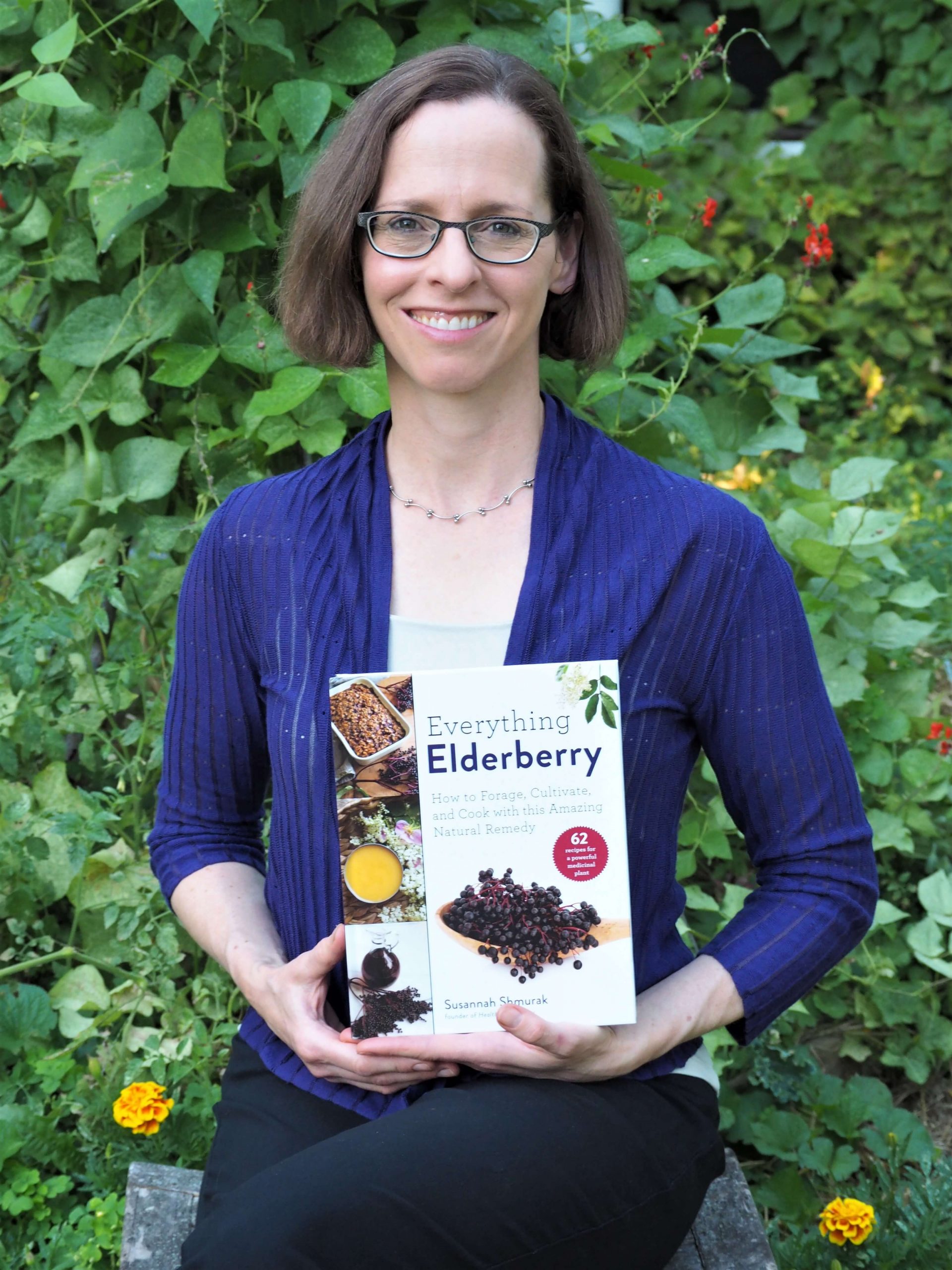
Susannah is a health and environmental writer focusing on gardening, foraging, medicinal plants, and sustainability. Her work has appeared in Mother Earth Living, Ensia, Northern Gardener, Sierra, and on numerous websites. Her first book, Everything Elderberry, released in September 2020 and was a #1 new release in holistic medicine, naturopathy, herb gardening, and other categories. Find out more and grab your copy here.
 Hi, I'm Susannah, a garden geek, energy nerd, and fan of healthy food and natural remedies. Need some simple, practical solutions for living healthier and greener? You've come to the right place! More about me and my green projects
Brenda K Gibbs says
Thank you so much for the great info on red elderberries. I got interested in elderberries three years ago for my own personal use. After moving and digging up my plants. I was so excited, looking for black elder berries this year. But after using the Plant Net app on my phone with photos from the leaves it said two of my plants were Sambucus Nigra and the other eight were red elder berries I was heart sick after researching and reading not to use red berries. Not wanting to dispose of them I decided to keep searching. Sometimes too much info just causes confusion. One thing that made me question was I kept reading that the red berry flowers stink. But mIne smells good so good. Then….I came across your website!! So thankful for the photos for comparing the flowers. Again, THANK YOU FOR YOUR WONDERFUL ARTICLE!!!! it was much appreciated.
Susannah says
Glad you found it helpful! So will you be using the flowers? Or experimenting with the preparation practices used by Native Americans? I also highly recommend planting some of our native elderberries (Sambucus canadensis) if you’re in North America. Here’s a post you might find useful on choosing varieties. Enjoy your elderberry adventures!
Emilee says
Thanks so much for the information on Red Elderberry. I’m finding that the berries look very similar to Mountain Ash berries. Do you have a guide for telling the difference?
Susannah says
They actually have some distinct differences that should help you tell them apart, plus they ripen at very different times. Red elderberry is a shrub, while mountain ash is a tree, and the clusters of fruit on an elderberry have a conical shape projecting from the branch, while mountain ash clusters droop. You’ll find ripe red elderberries very early in the season, and they’ll be long gone by the time mountain ash berries turn color closer to the end. Here’s more on identifying mountain ash. But really, there are so many more delicious things to forage, I would leave those two alone and look out for mulberries, juneberries, wild black raspberries, and black elderberries instead! But maybe you’re seeking a challenge. Drop a comment if you have any successful experiments with either plant 🙂
Mariana says
Hi there I’m working on a face scrub made with red elderberry if it is not safe to eat I think will work for the skin
Susannah says
Interesting! What is the elderberry meant to do for skin?
Jesse Downs says
I actually prefer using the flowers of red elderberries to those of black elderberries. They have a stronger flavor, some might say musky/unpleasant, but I enjoy it. I mostly use them for winemaking. I grew up in Northern Minnesota where S. racemosa is the only elderberry and now that I live in SW Wisconsin where black elderberries are more common I seek out the red elderflowers.
Susannah says
That’s so interesting! I don’t know anything about winemaking. Do you prefer red elder flowers for other uses as well?
Shawna says
Hi Jesse,
I’d love your Red Elderflower wine recipe. Could you describe the flavor?
Shawna says
Thank you for your thorough articsle. I have a large Red Elderberry that the birds planted beside my house. For fun I pruned it into a fan shaped espalier. It’s now about 15’ tall and loaded with red berries. It’s quite beautiful. Here in Northern Alberta sadly we can’t grow many of the berries you mentioned in a previous comment without much effort involving winter protection. Mulberry, black elderberry , black raspberry are borderline hardy.
Locally I forage Saskatoon berries (Amelanchier ), Black Currant, Rose hips, wild strawberry, wild red raspberry and chokecherry (Prunus virginiana)
Susannah says
Sounds like you’ve found some good things to forage that can survive that climate! Some cultivars of black elderberry grow in zone 3 if you want to find a local grower selling them and give them a try. My ‘Ranch’ is doing beautifully in zone 4. You’ll want to buy plants from someone in your area so they’re adapted to your extreme winters. Here’s more on the cultivars I’ve found in talking to growers: Elderberry Varieties for the Home Garden.