

I may receive commissions from purchases made through links in this article at no additional cost to you. Read full disclosure.
Ever heard of the velvet leaf plant (Abutilon theophrasti)? This common weed has edible seeds and leaves and may be growing in your garden right now. Here’s what to know about identifying and using the velvetleaf plant.

WHAT IS VELVET LEAF PLANT?
In the mallow family, you may have come across velvetleaf in disturbed areas of your yard. It’s a rampant self-seeding annual plant that may be perennial in warmer climates. Considered a noxious weed, it’s been causing problems for North American farmers since its introduction in the Colonial era, when fiber for rope was in great demand.
Also known as butter print, China jute, velvet weed, Indian mallow, and several other names, velvet leaf has been cultivated as a fiber crop in China for thousands of years.
Along with many other edible weeds like yellow wood sorrel, chickweed, common mallow, and Canadian wood nettle, I’ve found velvet leaf plants in my garden every season. I’ve admired the softness of its velvety leaves as I toss them into the weed bucket.
After so many years learning that the wild plants most people call weeds have many culinary and medicinal uses, I now always look up anything I find in the garden before yanking it.
Some turn out to be delicious and welcome — wild violets, for example, which now form a no-maintenance groundcover in the front yard and wind up in many pots of tea each season — while others, like Virginia waterleaf, are too aggressive and not tasty enough to be welcome in the wilds of my not-very-tidy little plot.
Velvetleaf falls into this latter camp. Not yummy enough to be allowed to do what it wants, and much too invasive. Nevertheless, if you find it you may as well see if there’s any use you can put it to. More on that below.
Because velvetleaf is a noxious weed that causes trouble for farmers, it’s best to pull it before it can set seed.
I’ve read that when destroyed, the leaves exude a compound that inhibits the growth of other plants, so I’d advise caution adding this one to your compost pile or allowing it to grow near other plants you’d like to thrive.
–> Don’t confuse this velvet leaf plant, Abutilon theophrasti, with a common houseplant called velvet leaf philodendron (Philodendron micans), which by the way, is poisonous to both humans and pets.
IS VELVET LEAF POISONOUS OR EDIBLE?
Whether or not you consider velvet leaf edible depends on who you talk to. Many plants are technically edible, but they don’t taste that great. Clover and creeping Charlie, for example, though I’ve really come to appreciate creeping Charlie as a medicinal tea.
In the case of velvet leaf, though apparently it’s used as a cooking green in some parts of the world, my favorite foraging expert, Sam Thayer, has written that its “youngest leaves can be eaten cooked but are pretty lame.” Not exactly high praise! He also reports that stem tips can be peeled and eaten, but have “an odd musky flavor.”
It’s the unripe seeds most people who bother with velvetleaf snack on. The ripe seeds need to be boiled before consuming and are sometimes used to make hot cereal or flour. They have a high oil content, so they can be pressed for oil as well.
In the Peterson Guide to Medicinal Plants and Herbs, authors Stephen Foster and James Duke note that the Chinese use an infusion of dried leaf for dysentery and fevers. They also report that the dried root of the velvet leaf plant is made into a tea used for dysentery and urinary incontinence, and that the seed powder is a diuretic used for dysentery and stomaches.
Oh, and while not an edible use, those of you into camping or survival skills should know: Though the leaves aren’t worth eating, according to Thayer, their use as foraged toilet paper is “way, way up there.” 😉
FORAGING VELVET LEAF (& OTHER WILD PLANTS)
To forage safely, always follow the rules of foraging:
1. IDENTIFY PLANTS USING MULTIPLE FEATURES
ALWAYS positively identify plants using multiple features, including growth habit, shape and arrangement of leaves, shape and arrangement of flowers, color, shape, and arrangement of fruit, and what the bark looks like.
Identifying plants from the fruit alone, for example, leads people to eat things that aren’t safe.
2. CHECK THE AREA ISN’T CONTAMINATED WITH CHEMICALS
Whenever you forage wild plants, be sure the areas hasn’t been sprayed with hazardous chemicals. Be aware that areas with a history of industrial use or near roadways may also have persistent contaminants like arsenic and lead, which can be taken up by plant tissues.
3. MAKE SURE YOU HAVE PERMISSION
Always get permission to forage. Even some “public” areas (like state parks) may not allow harvesting of plants growing there. Check that what you’re foraging isn’t on the list of threatened or endangered species.
4. GET EXPERT ADVICE
Want to hone your plant identification skills? Try a course like the Herbal Academy’s online foraging or wildcrafting courses.
Be sure to keep a good foraging guide handy. Check out some of the best foraging books to add to your bookshelf. A must-have: Sam Thayer’s Field Guide to Edible Wild Plants, the most comprehensive foraging guide I’ve ever come across.
VELVET LEAF IDENTIFICATION
Velvetleaf is pretty easy to identify, and according to Sam Thayer it doesn’t have any look alikes would-be foragers need to know.
GROWTH HABIT

Velvetleaf grows with a thick central stem up to 8 feet tall, though the plants I tend to find in my garden are considerably smaller, some with seed heads ripening when they’re only a foot tall.
Stems are round and covered with fine hairs. At maturity, they can be peeled in strips that can be used to make cordage.
LEAVES

Velvetleaf’s large, heart-shaped leaves are covered on both sides with tiny hairs that make the leaf feel remarkably soft. They grow in an alternate pattern and have pointed tips. They have long petioles (stems) attached to the central stem.
I’ve read that the leaves give off an unpleasant odor when crushed, but after crushing up many leaves on the plants growing in my garden, I have yet to detect much beyond the typical vegetal smell of most wild plants I’ve sniffed.
FLOWERS

Flowers emerge on individual stems from the leaf axils. They’re yellow with 5 petals and 5 green sepals, which are also covered with fine, soft hairs.
FRUIT

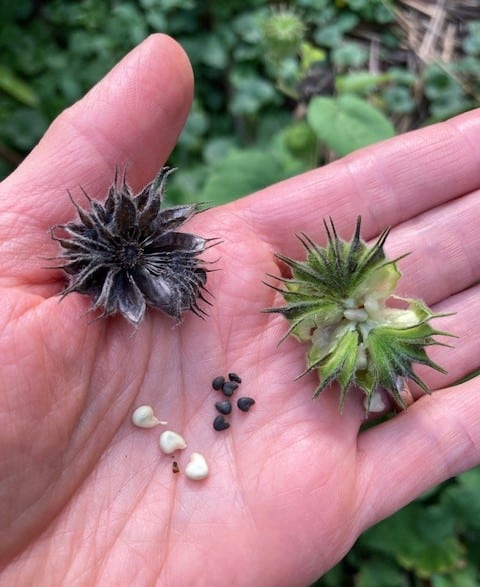
The flowers will become interesting-looking round green seed pods with a ring of prickles at the top. Pods are divided into 10 to 15 sections, each containing several heart-shaped seeds that are white when unripe, as seen in the photo below.

When mature, the seed pods turn brown, as do the hard seeds, which reportedly can remain viable in the soil for decades.
USING VELVET LEAF
Velvetleaf is generally not considered a prime wild plant for foraging, but if you’re looking for something unusual to nibble, you could try some of the immature seeds. Or grind up some of the more mature seeds to make a foraged flour. This video has more on using velvetleaf seeds for flour.
Remember velvetleaf’s history as a fiber used for rope? It is indeed a good source of cordage if you need some. This video offers some guidance on using velvetleaf fibers for rope-making.
Or if you’re in need of toilet paper the next time you go camping, be on the lookout for velvetleaf plants!
Looking for tastier wild plants to forage? We cover plenty! Check out some of our favorites:
Save this info on velvet leaf plant for later!

Photo credits for cover and pins: NNehring, emilio100
Disclaimers: Though HealthyGreenSavvy and EcoSavvy Writing LLC always aim to provide thorough and accurate information, we assume no liability or responsibility for any consequences, health issues, or symptoms that arise from ingesting or touching any plant described on this website. It is always the reader’s responsibility to ensure accurate plant identification and use multiple reputable sources to confirm. If you have any doubts about the identification of any plant, do not eat it.
Susannah is a health and environmental writer focusing on gardening, foraging, medicinal plants, and sustainability. Her work has appeared in Mother Earth Living, Ensia, Northern Gardener, Sierra, and on numerous websites. Her first book, Everything Elderberry, released in September 2020 and was a #1 new release in holistic medicine, naturopathy, herb gardening, and other categories. Find out more and grab your copy here.

 Hi, I'm Susannah, a garden geek, energy nerd, and fan of healthy food and natural remedies. Need some simple, practical solutions for living healthier and greener? You've come to the right place! More about me and my green projects
Leave a Reply